

Why overthinking has become a form of entertainment
We are no longer just thinking too much, we are getting trapped in thought loops that feel strangely addictive

There was a time when overthinking was something you wanted to escape.
Now it is something people quietly spend hours inside.
We replay conversations, analyze messages, predict outcomes, and reconstruct entire scenarios that never happened. Not because it helps, but because it feels strangely engaging. Like watching a movie where you already know the ending might be nothing.
Overthinking used to feel like a problem. Increasingly, it feels like a habit that sits somewhere between anxiety and entertainment.
Part of this shift comes from how mentally stimulated modern life has become. We are constantly consuming information, opinions, and perspectives. The mind rarely gets a break, so it starts generating its own content when nothing external is available.
And the easiest content for the brain to produce is uncertainty.
What did that message mean? Did I sound weird? What if that goes wrong? What if I said something different?
Each question creates a loop. And each loop creates just enough tension to keep attention locked in.

The strange part is that overthinking does not always feel bad in the moment.
It feels active. Engaged. Like you are “figuring something out.”
Even when nothing is actually being solved.
You are not moving toward clarity, but it feels like movement. And in a world where stillness feels uncomfortable, mental movement can feel like productivity.
There is also a social layer to this.
We are more self-aware than ever before. We are constantly exposed to language about attachment styles, trauma responses, communication patterns, emotional intelligence, and personal growth.
This awareness is useful. But it also creates a second layer of thinking: not just what you feel, but what your feelings mean.
So instead of simply being hurt, you analyze why you are hurt. Instead of being anxious, you evaluate your anxiety. Instead of reacting, you interpret your reaction.
You stop experiencing directly and start observing yourself experiencing.
“We don’t just think anymore. We monitor our thinking.”
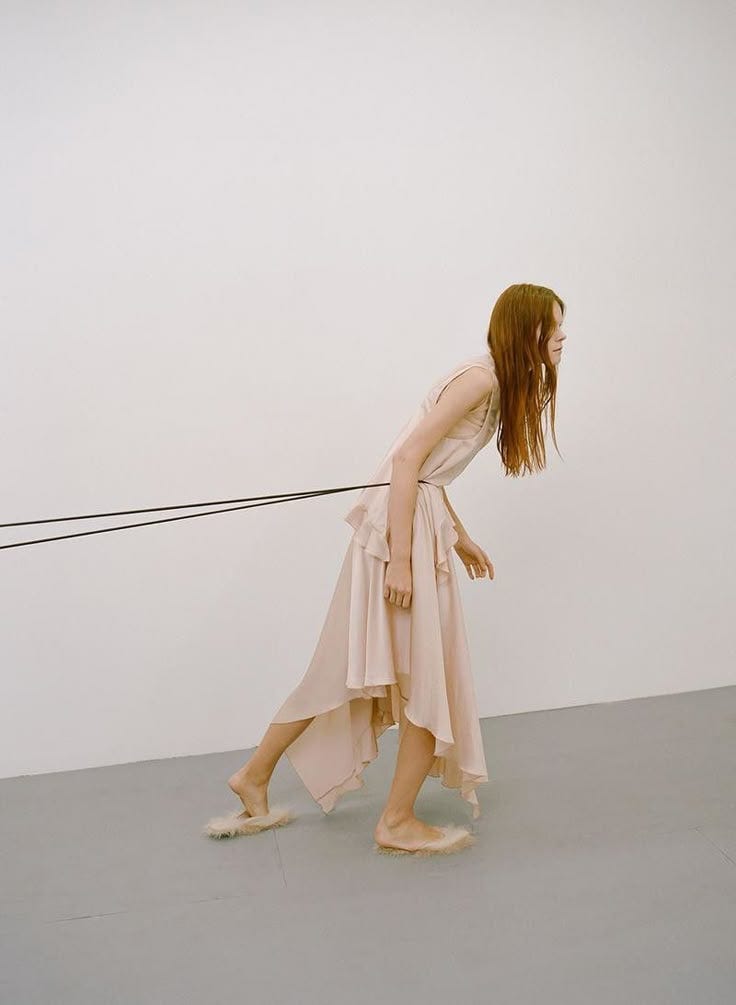
That distance creates a loop.
Because once you start analyzing your mind, your mind becomes something that can be analyzed endlessly.
And there is no natural endpoint to interpretation.
Every explanation leads to another question. Every answer creates another angle. The mind becomes a system that feeds itself.
This is where overthinking quietly turns into entertainment.
Not because it is enjoyable in a happy sense, but because it is absorbing. It fills silence. It creates narrative. It produces emotional variation in an otherwise static moment.
A neutral situation becomes a story. A simple interaction becomes layered with meaning. A delayed reply becomes a plot point.
And suddenly, your inner world becomes more eventful than your outer one.
The irony is that overthinking often starts as a search for certainty.
But it ends by multiplying uncertainty in more detailed forms.
You are not trying to feel worse. You are trying to feel sure. But the mind, left unchecked, does not naturally produce certainty. It produces possibilities.
And possibilities are infinite.

This is why overthinking can feel so hard to stop.
Because it is not just anxiety. It is also engagement. It is mental activity that feels meaningful enough to stay inside, even when it is draining.
“Overthinking is what happens when the mind refuses to leave its own story.”
The challenge is not to stop thinking altogether. That is not realistic. The challenge is recognizing when thinking has stopped being useful and started becoming immersive.
Because once thought becomes entertainment, it no longer needs a problem to justify itself.
It only needs attention.
And attention, once given, is very hard to return.
With love,
Mara
New essays twice a week.
Paid subscribers get a private letter once a month, an printable happiness bingo and much more.
If you liked this piece you might also like this one:
We’re living in the age of emotional numbness disguised as calm

There is a new kind of tired that doesn’t look like exhaustion anymore.
This is such a sharp diagnosis of the 'attention trap.' We think we’re moving toward clarity, but we’re really just engaging with possibilities because the mind hates silence. Your closing thought—that we need to recognize when thinking stops being useful and starts being immersive—is exactly the boundary I think we all need to start drawing. An essential read for anyone living in this hyper-stimulated world.
As someone who works in an industry that demands constant problem-solving, recognizing this 'loop' is quite a game-changer for me. It’s the kind of clarity that makes the silence feel a bit more comfortable again.
"You stop experiencing directly and start observing yourself experiencing." this is so true! the analysis loop of why you're thinking and feeling a certain way is one ive definitely been stuck in one too many times